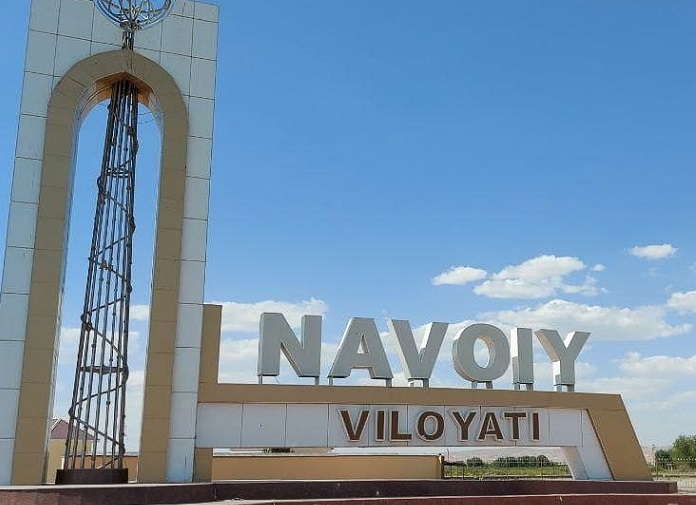
 Photo: daryo.uz.
Uzbek President Shavkat Mirziyoyev has instructed authorities in the Navoi region to attract $4.2 billion in foreign investment this year and increase exports to $1.5 billion. Officials were also told to pay special attention to supporting small and medium-sized businesses and expanding their role in localization. The targets were announced at a meeting on the region’s social and economic development, according to the presidential press service.
Large enterprises have traditionally driven the Navoi region’s economy, including the Navoi Mining and Metallurgical Combine, Navoiyuran, and Kyzylkumcement. Recently, however, new growth points have emerged. Last year, regional investment not linked to major industrial enterprises reached $1.4 billion. The president instructed officials to raise this figure to $2 billion this year.
According to data presented at the meeting, the region’s gross product grew by 7.7 percent in 2025 to reach 168 trillion soums ($13.6 billion). Industrial output rose by 8.3 percent, agriculture by 4.7 percent, and services by 13.7 percent. Some 161,000 jobs were created, while unemployment and poverty fell to 4.2 percent.
Mirziyoyev stressed the need to continue reforms by developing each city and district based on its competitive advantages. Nurota and Gazgan have potential in decorative stone production and tourism; Navbahor in textiles and horticulture; and Zarafshan in jewelry and IT.
Development across districts remains uneven. Although industrial output per capita averages 177 million soums ($14,300), several districts, including resource-rich ones, fall below this level. In response, key projects were approved, including the creation of an industrial granite park and a decorative stone processing cluster in Nurota district.
Officials also discussed making fuller use of agricultural potential by developing sheep, camel, and horse breeding. Some 3.3 million hectares of pastureland will be brought into agricultural use, and advanced Chinese practices will be applied to combat desertification.
Tourism was highlighted as a priority. This year, the region aims to attract 600,000 foreign and 3 million domestic tourists, create 72 new accommodation facilities, and generate 500,000 jobs. Trade and entertainment facilities, guesthouses, and specialized tourism centers will be built in mahallas (local communities). A complex called “Ancient Karmana” is planned in Karmana. Officials were also instructed to develop desert and pasture tourism using the experience of Saudi Arabia, Qatar, and the UAE.
On the social front, the president noted that the region is among the country’s leaders in education. Higher education enrollment stands at 71 percent, and in 2025 graduates from 10 schools achieved a 100 percent university admission rate. Starting next academic year, specialized classes under the “One school — one IT class” principle will open in Navoi and Zarafshan. As part of this effort, 100 teachers will undergo advanced training in Tashkent and abroad, and the Zarafshan branch of Tashkent University of Information Technologies will launch programs in artificial intelligence and cybersecurity.
Infrastructure issues were also addressed. Between 2026 and 2028, authorities plan to gradually modernize 312 kilometers of water supply and 124 kilometers of sewage networks in Navoi, Zarafshan, Uchkuduk, and Zafarabad. Local officials were also tasked with creating modern sanitary conditions in schools, kindergartens, and medical facilities across the region.