 Photo from economist.kg
Representatives of Kyrgyzstan's Ministry of Emergency Situations and Russia's state nuclear corporation Rosatom have announced the completion of reclamation work at several uranium tailings sites across the Central Asian republic. The project, which secured facilities left over from the Soviet atomic program, cost more than 2 billion rubles ($29.15 million), according to Economist.kg.
The work was carried out under the Interstate Target Program «Reclamation of Territories of States Affected by Uranium Mining Operations,» implemented under CIS auspices. Costs were shared among participating states: Russia contributed 75%, Kazakhstan 15%, and Tajikistan and Kyrgyzstan 5% each.
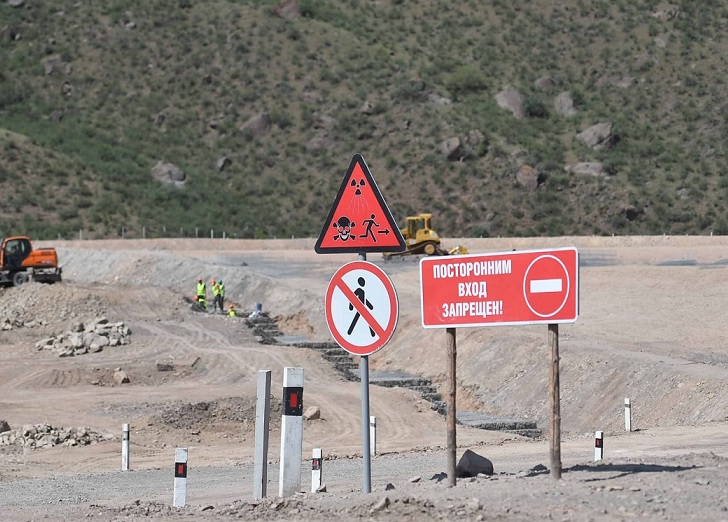
The first phase of the project covered two regions of Kyrgyzstan. At Kadzhi-Sai village in the Issyk-Kul region, specialists fully reclaimed a tailings site, completing 185,000 cubic meters of earthworks, reconstructing 2.8 kilometers of access roads, and building additional protective sections. A retaining dam and protective barrier were erected along the site's perimeter, a new water channel was laid to redirect drainage flow, and the existing fencing was fully restored.
In Min-Kush village in the Naryn region, approximately 1.5 million cubic meters of material from the Taldy-Bulak and Tuyuk-Su tailings sites were relocated to a third facility, Dalneye. Bridges were built to transport radioactive waste, engineering platforms were established, and a 1.7-kilometer road section was reconstructed. The receiving site also underwent deep reconstruction with additional protective measures, and experts now consider Dalneye fully reclaimed as well.
Kyrgyz Emergency Situations Minister Kanatbek Chynybaev praised the coordinated effort, saying the closure of the tailings sites would support the social and economic development of communities near former production facilities. Rosatom CEO Alexey Likhachev said the program brought 27 hectares of land across two regions into a safe condition. Deputy CEO Nikolay Spassky described the elimination of the hazardous legacy as a moral duty, adding that the project employed technologies with no equivalents elsewhere in the world.
Kyrgyzstan's Emergency Situations Ministry and Rosatom signed a protocol confirming the completion of the work and approved a new remediation plan for contaminated areas covering 2026–2028. Spassky said the program would continue in a bilateral format between Russia and Kyrgyzstan, with even larger volumes of work planned. «We will not leave until we have done everything,» he stated.