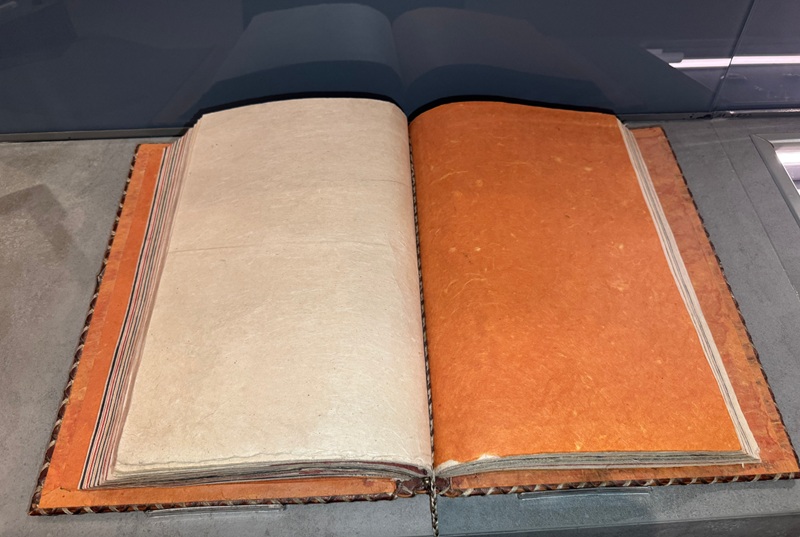
 Samarkand paper. Photo: press service of the Center for Islamic Civilization.
The renowned Samarkand paper has become part of the museum collection of the Center for Islamic Civilization in Uzbekistan, the Center’s press service reports.
Examples of Samarkand paper are displayed in the Hall of the First Renaissance. In addition, the “Wall of Civilizations and Discoveries” features video material on the papermaking process, and visitors can examine samples up close.
“Some sources link the spread of this technology to events following the Battle of Talas, when Chinese craftsmen passed on papermaking skills. At the same time, a number of researchers point to the existence of local traditions even before that period. As a result, the Samarkand school of papermaking took shape and developed over subsequent centuries. The samples in the exhibition are produced using traditional techniques—visitors can hold them and study the structure of the sheet,” said senior museum researcher Obidjon Tangirov.
Samarkand paper is considered a unique example of Uzbekistan’s cultural heritage. The craft tradition, formed in the eighth century, spread along Silk Road routes and supported the exchange of knowledge between regions. Under the Timurids, the tradition developed further and contributed to a flourishing of science and the arts, with a number of scholarly works of that era written on Samarkand paper.
The paper is made primarily from mulberry bark. The production cycle includes several stages: harvesting and soaking the bark, boiling it for five to six hours, pounding it with wooden mallets, forming sheets in special frames, drying, and polishing. The technology preserves traditional principles: each sheet is handmade and has an individual texture.
The material is known for its strength and high quality. Samarkand paper has a yellowish-cream hue and absorbs ink and pigments well. These properties have helped preserve many ancient manuscripts, including certain copies of the Quran and scholarly treatises.
Samarkand papermaking is inscribed on UNESCO’s Representative List of the Intangible Cultural Heritage of Humanity by UNESCO. Production using classical techniques has been revived at the Meros workshop, located in the tourist village of Konigil.
The Center for Islamic Civilization was built in Tashkent near the Hast-Imam complex. The building is designed in the style of medieval architectural monuments, with four portals 34 meters high and a central dome rising 65 meters. It includes a Quran hall, a 460-seat conference hall, and a museum whose exhibitions cover the full history of Uzbekistan from pre-Islamic times to the present. The Center is intended as a platform for studying the legacy of past generations and its contemporary interpretation in cooperation with the International Islamic Academy of Uzbekistan and scholarly and educational centers around the world.