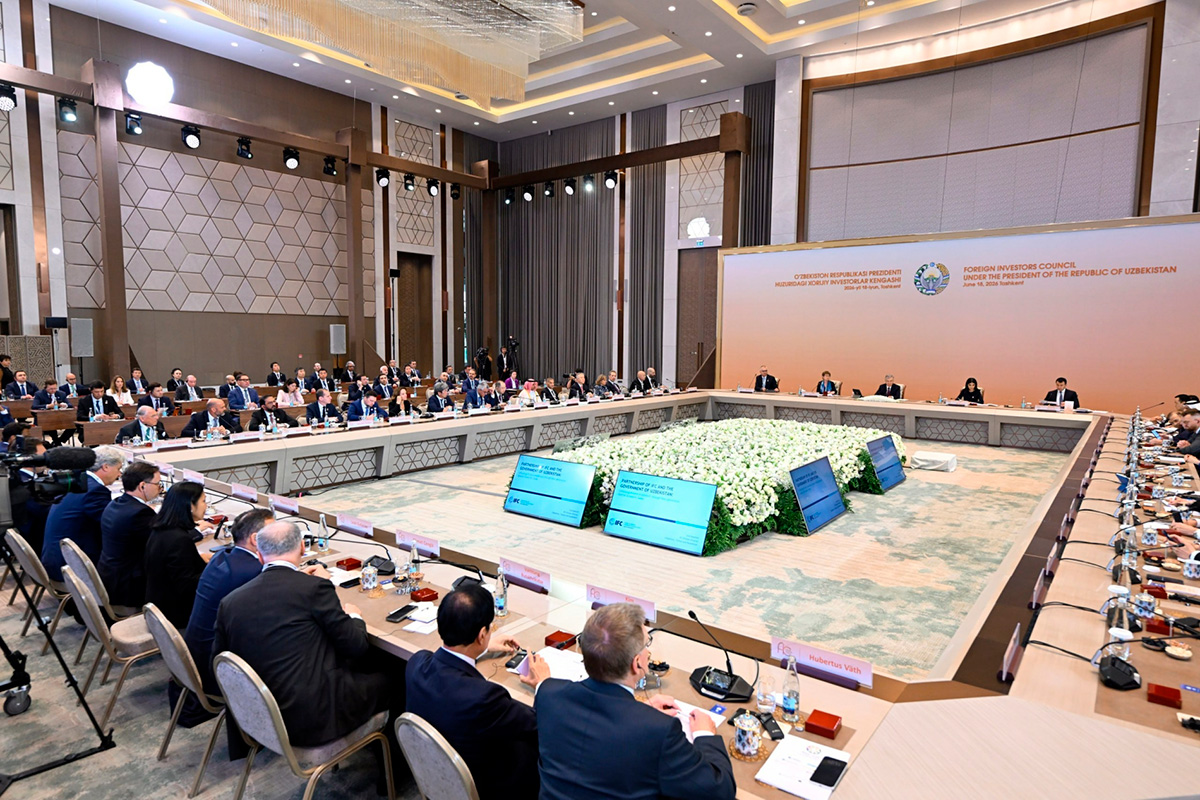
 Meeting of the Foreign Investors Council. Photo from the press service of the President of Uzbekistan
The government of Uzbekistan will compile a single “roadmap” based on 120 proposals submitted by foreign companies, President Shavkat Mirziyoyev announced at a meeting of the Foreign Investors Council.
The meeting was held on June 18 in Tashkent and was attended by European Bank for Reconstruction and Development (EBRD) President Odile Renaud-Basso, heads of international organizations, major foreign companies, banks, financial institutions, and representatives of investor councils from Central Asia and the Caucasus.
Mirziyoyev said the Council has evolved from an advisory body into a platform for practical reforms and has gained the status of an independent association. The number of participating companies rose from 54 to 85 last year, spanning 23 sectors. The Council’s Executive Committee includes the EBRD, the Asian Development Bank (ADB), and the International Finance Corporation (IFC).
According to the president, 21 concrete solutions to investor proposals were identified at the previous meeting, many of which have since been incorporated into state policy. Amendments to the Tax Code were introduced to support investors, including exempting intra-company loan agreements from financial oversight and granting accelerated depreciation of fixed assets. Several mandatory reporting requirements for foreign companies using international standards were also scrapped.
Authorities have also drafted a law “On Alternative Investment Funds,” developed a program to implement responsible business conduct standards, and prepared a plan to align 16 technical regulations with international norms. A Constitutional Law on the Tashkent International Financial Center is expected to be adopted.
Uzbekistan has additionally applied to join the OECD Declaration on International Investment and Multinational Enterprises.
Ahead of the meeting, investors submitted 120 new proposals. The government reviewed them and grouped them into seven priority areas: improving the investment climate, tax policy, the cadastre system, energy, banking and finance, corporate governance, and the development of artificial intelligence and the digital economy.
Particular attention was given to proposals aimed at simplifying currency monitoring and introducing new financial instruments such as Islamic insurance, green lending, and the sale of distressed banking assets. Investors also called for wider adoption of ESG (Environmental, Social, Governance) principles covering environmental protection, social responsibility, and corporate governance.
Officials have been assigned to each of the seven areas, with specific solutions already outlined. Working groups will be co-chaired by executives from Vision Invest, BDO, Crowe, OTP Group, Franklin Templeton, Ernst & Young, Costa Legal, and ACWA Power.
Mirziyoyev instructed that all proposals be consolidated into a unified roadmap. Deputy Prime Minister Jamshid Khodjayev and Minister of Investments, Industry and Trade Laziz Kudratov will report quarterly to the president on its implementation.
“All initiatives from our truly close partners will serve the well-being of the people and improve the investment climate in the country,” Mirziyoyev said.
He added that the government remains open to candid dialogue with investors and is ready to consider proposals to improve the Council’s work.
The Foreign Investors Council under the President of Uzbekistan was established in November 2019. Its mandate includes identifying key barriers to investment, developing solutions jointly with state bodies, and ensuring a favorable investment climate. The president chairs the Council, while the EBRD president serves as co-chair. Since its creation, four plenary sessions have been held.