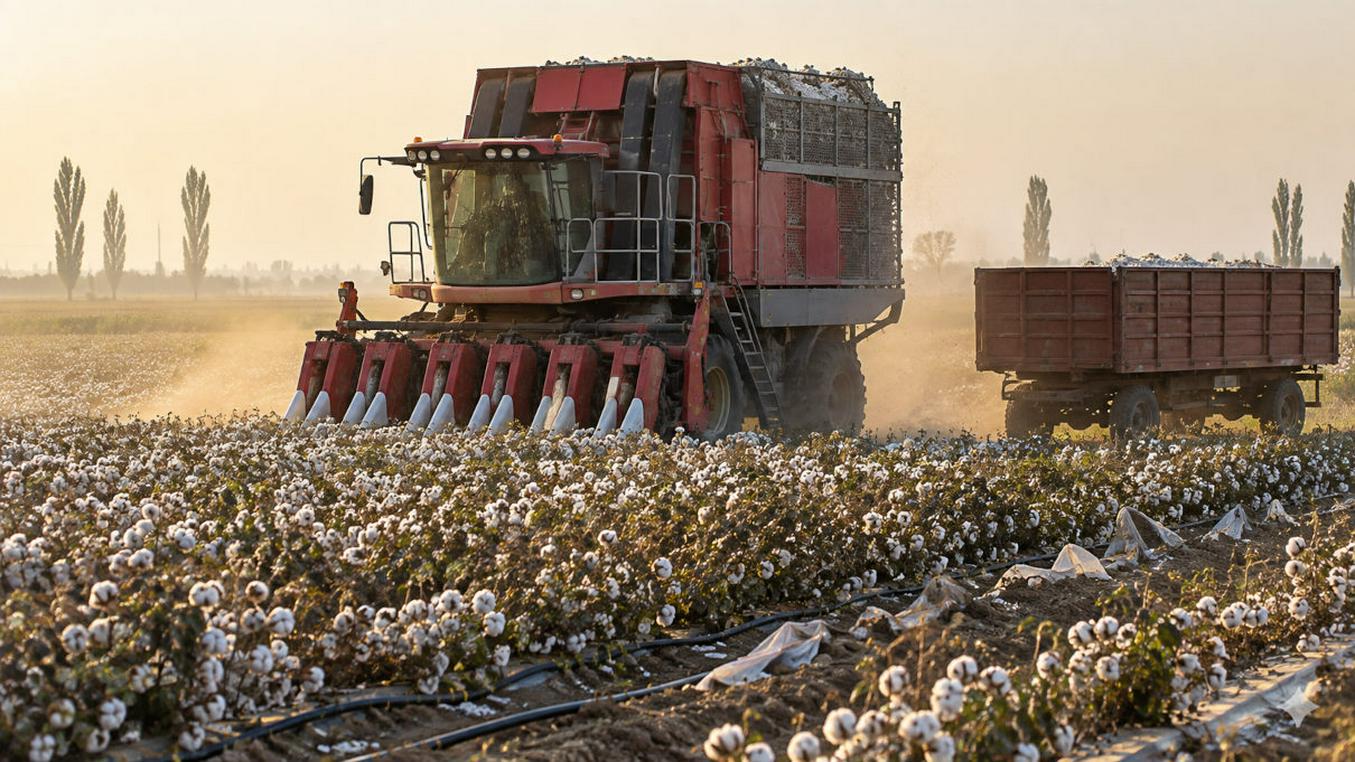
On September 23, 2026, Uzbek President Shavkat Mirziyoyev visited Andijan Region to inspect cotton cultivation using a technology adapted from China’s Xinjiang, as the presidential press service reported. He was shown dense double-row planting under plastic mulch, drip irrigation delivering fertilisers directly to plant roots, and the use of drones. According to the administration, the new technology increases yields, saves water and fertiliser, and allows harvesting to begin earlier.
At the demonstration site of the Oltinkul Agrocluster, however, the method is currently used on just 23 hectares out of 850.
Beyond individual demonstration fields, the Xinjiang approach is already spreading across hundreds of thousands of hectares. At the same time, the area planted with foreign varieties is increasing, drip irrigation is expanding, and agricultural machinery is being purchased. The authorities are also preparing a new agricultural subsidy system: from 2027, state support is expected to take into account yields, water and energy savings, and output per unit of resources used.
For Uzbekistan, this is another stage in the restructuring of an industry that has occupied a special place in the country’s economy for decades. Uzbek cotton production has already gone through the abolition of state procurement quotas, the creation of cotton-textile clusters, the end of systematic forced labour, a reduction in raw-fibre exports, and the expansion of domestic processing. Now the production technology itself is changing.
Fergana examines how the Xinjiang method works, what results it produces, how much it costs, and what its expansion across a significant share of Uzbekistan’s cotton fields could mean.
From “White Gold” to Textile Clusters
Cotton was grown in Central Asia long before the Soviet period, but it was the Soviet model that turned it into Uzbekistan’s main agricultural specialisation. Irrigated areas were expanded, canals were built, and Moscow assigned the republic the role of a major supplier of raw materials. According to the Food and Agriculture Organization of the United Nations (FAO), Uzbekistan accounted for around 61% of the cotton produced in the Soviet Union.
The expansion of cotton fields required enormous volumes of water from the Amu Darya and Syr Darya rivers and became one of the main causes of the Aral Sea’s disappearance. After 1960, cotton occupied around 60% of Uzbekistan’s cultivated land, while the area of irrigated land reached approximately 4.2 million hectares by the end of the Soviet period.
After 1991, the system did not change immediately. The state continued to determine the areas planted with cotton, set production targets and purchase the harvest, while farmers remained dependent on meeting the plan. The last state production plan was in effect in 2019; in 2020, mandatory quotas and state procurement were abolished. By then, a significant share of production had already been transferred to cotton-textile clusters combining raw-material production with processing.
The cotton harvest was also changing. For many years, it had been associated with the mass mobilisation of workers, including forced labour. According to the International Labour Organization (ILO), around two million people took part in the harvest in 2020, two-thirds of them women, mostly from rural areas.
After the 2021 season, the ILO said that systematic child and forced labour had been eliminated. In March 2022, the Cotton Campaign coalition ended its call for a global boycott of Uzbek cotton, which had been in place for more than a decade.
Exports changed as well. Instead of mainly selling raw fibre, the state began focusing on domestic processing. According to the World Bank, since 2023 Uzbekistan has had the capacity to process all of its domestically grown cotton into yarn. Employment in the textile industry increased from 188,000 people in 2018 to approximately 600,000 in 2024.
The next reserve for growth was productivity. Cotton-growing areas are now considerably smaller than during the Soviet period, water resources are becoming increasingly scarce, while the textile industry needs a stable supply of raw materials. According to Review.uz, the area planted with cotton fell from 1.3 million hectares in 2016 to 875,000 hectares in 2025, while yields increased from 23.4 to 46 centners per hectare. Against this backdrop, attention turned to the experience of China’s largest cotton-producing region.
How Cotton Is Grown in Xinjiang
Xinjiang effectively dominates China’s cotton production. In 2025, the region produced 6.165 million tonnes of cotton, or 92.8% of China’s total output. According to regional authorities, the overall level of mechanisation in cultivation and harvesting exceeds 97%, while more than 90% of the crop is harvested mechanically. Precision seeding using navigation systems, automated delivery of water and fertiliser, and drone-based crop treatment have become standard elements of production.
One of the key elements of the system is drip irrigation beneath plastic mulch. After sowing, the soil is covered with a thin polymer film that reduces evaporation and retains moisture and heat, which is particularly important in the dry spring climate. Drip lines are laid beneath the film, delivering water and dissolved fertilisers directly to the plants.
Seeds are planted more densely than under Uzbekistan’s traditional planting system. The country’s Ministry of Agriculture has described the Xinjiang model as double-row planting with a 76-by-10-centimetre spacing, producing approximately 240,000 plants per hectare. The configuration is also designed to facilitate subsequent mechanised operations.
The term “Xinjiang technology” is a broad one. Yields result from a combination of plant density, seed variety, plastic mulch, drip irrigation, fertiliser application regimes, mechanisation and precise timing of agricultural operations. The specific combination may vary from one farm to another.
6–7 Tonnes per Hectare
Yield has been the central figure in the presentation. According to the presidential administration, conventional cultivation at Oltinkul produces an average of 30–35 centners of cotton per hectare, while the Xinjiang technology produces 60–70 centners. Water consumption is reduced by 40%, fertiliser use by almost 30%, and harvesting can begin 10–15 days earlier.
The comparison does indeed indicate a doubling of yield, but there are important qualifications. The figures come from just 23 hectares out of the cluster’s 850 hectares, while the 30–35-centner benchmark is significantly below the national average. In 2025, Uzbekistan harvested around 4 million tonnes of raw cotton from 875,000 hectares, and average yield reached 46 centners for the first time, according to a statement by the president in December. At the time, he also said that around 1,500 farmers had achieved yields of 70 centners or more.
The effect of new varieties had already been tested. In 2024, foreign high-yield varieties were trialled on approximately 100,000 hectares. According to the Ministry of Agriculture, average yields reached 42 centners, compared with 26–30 centners for local varieties.
Research in Xinjiang itself confirms that yields of more than five tonnes of raw cotton per hectare are achievable with drip irrigation under plastic mulch. In a two-year experiment involving different types of mulching, the average yield with conventional polyethylene film was around 5.48 tonnes per hectare, compared with approximately 5.36 tonnes when biodegradable film was used.
However, results depend heavily on irrigation practices, water and soil salinity, the variety used, fertiliser application and planting density. Demonstration-field results therefore cannot simply be extrapolated to all farms.
The scale of the programme now makes it possible to test the technology across much larger areas. For 2026, the authorities had planned to apply the Xinjiang approach to approximately 300,000 hectares. In July, the Ministry of Agriculture reported that cotton was being grown using this method on 305,200 hectares, out of a total planted area of 889,500 hectares — roughly one-third of the country’s cotton fields.
The published data do not make it possible to determine whether the full package demonstrated at Oltinkul is being used across all of this area. In official communications, the term “Xinjiang method” is used broadly.
Water Becomes the Key Resource
Agriculture accounts for around 90% of Uzbekistan’s water use, with major volumes coming from the transboundary Amu Darya and Syr Darya rivers. The World Bank projects that climate change could reduce water availability in Uzbekistan by 30–40%, while irrigation demand could increase by approximately 25%.
This is why the 40% reduction in irrigation water claimed at Oltinkul is significant. The administration cites this figure for the specific project, while scientific research shows that actual water savings depend on irrigation practices. In a two-year field experiment published in 2026, drip irrigation under plastic mulch was compared with conventional flood irrigation. Under an optimised irrigation regime, total water consumption was 8.1–15.5% lower, while water productivity increased.
The effect comes from combining drip irrigation with an appropriate irrigation rate.
Uzbekistan has been introducing water-saving technologies for several years independently of the Chinese programme. By February 2026, according to the presidential administration, such technologies had been introduced on 2.6 million hectares, or 60% of irrigated land, with annual water savings estimated at 2.5 billion cubic metres. The government plans to increase the area to 3.5 million hectares by 2028.
In cotton production, this policy is now being combined with an intensive cultivation system. For 300,000 hectares, the government has allocated 2.6 trillion soums — approximately $220 million — in preferential loans for drip irrigation.
How Much Does Xinjiang-Style Cotton Cost?
The technology requires investment even before the first harvest: plastic mulch and drip lines, equipment for delivering water and fertiliser, and suitable seeders are needed. As mechanisation increases, additional costs include harvesters, servicing, fuel, spare parts and specialists.
In 2025, the Ministry of Agriculture valued seeders adapted to intensive cultivation at 57–78 million soums, or approximately $4,800–6,600. Farmers were offered leases of up to five years with a 20% down payment, or the option of using cluster services. Chinese cotton harvesters were valued in the same announcement at approximately 3.65 billion soums, or $309,000; US-made John Deere machines at 6.7 billion soums, or $567,000; and Case machines at 4.95 billion soums, or $419,000.
The state covers part of the costs. In 2024, the authorities reported a subsidy of 8 million soums, or approximately $680, per hectare for introducing water-saving systems, while preferential financing has become the main instrument for expanding the technology.
The full economics of the Oltinkul project are not available in the public domain. The administration describes the project as economically efficient but does not provide the cost of equipment per hectare, the payback period, the cost of plastic film and its removal, the cost of maintaining drip lines, or net profit compared with conventional cultivation.
From 2027, the authorities also plan to change the subsidy system. In 2026, the agricultural sector has 91 types of subsidies across 29 areas, worth 2.7 trillion soums, or approximately $229 million. The new system is expected to take into account yields, water and energy savings, and output per unit of resources used. Under such an approach, the technology’s effectiveness will ultimately have to be assessed on the basis of actual field results.
What Is Left Behind by the Plastic?
Plastic mulch has helped Xinjiang grow cotton in its arid climate for decades. Over that time, however, another well-documented problem has accumulated: plastic residues in the soil. A 2025 study of 22 sites in different parts of Xinjiang found a relationship between the duration of plastic-film use and the amount of microplastic in the soil.
In another study published in 2026, researchers examined fields with different histories of plastic-film cultivation and found that over 26 years the amount of plastic residue in the upper 40 centimetres of soil had increased 16.7-fold. The plastic altered soil structure and water movement.
Experiments have also shown effects on the plants themselves. A study of the 2024–2025 cotton harvest in Xinjiang recorded deterioration in the root zone and declining yields as the amount of residual plastic increased.
The use of agricultural plastic film in Xinjiang is regulated by specific rules, an updated version of which entered into force in May 2024. The rules establish requirements for the quality of the material and require farms to collect used film after harvesting and deliver it to collection points. Local authorities are required to establish collection and recycling networks, while producers, sellers and users are responsible for returning the material. The rules also provide support for biodegradable materials and machinery for collecting plastic from fields.
Uzbekistan has previously raised the issue of waste from drip-irrigation systems, including the recycling of disposable hoses. However, published materials on the Xinjiang technology programme do not yet describe a dedicated system for collecting and recycling plastic mulch in detail.
Machines Instead of Mass Harvesting
Another element of the Xinjiang model is a high level of mechanisation. The Chinese region has moved to mechanical harvesting for more than 90% of its cotton. Planting patterns, row spacing, varieties and ripening times are selected partly with the operation of harvesting machinery in mind.
Uzbekistan is rapidly expanding its own fleet. By February 2026, the country had purchased 1,756 cotton harvesters, and the share of mechanised harvesting had reached 52%. During the 2025 season, machines harvested 2.1 million tonnes of cotton. According to the authorities, the volume of manual labour had fallen 1.8-fold over five years. For 2026, the government planned to purchase another 800 machines and raise the share of mechanised harvesting to at least 70%.
This transformation also has a social dimension. Until only a few years ago, the cotton harvest remained the country’s largest annual seasonal employment campaign, and for many rural residents cotton picking was an important source of cash income. As mechanisation expands, such jobs are becoming less numerous, while employment in spinning, weaving and garment production is growing: according to the World Bank, the number of workers in the textile industry more than tripled between 2018 and 2024.
Factory employment and seasonal harvesting differ in terms of location, working hours and skill requirements.
In the current season, the Xinjiang method is being used on approximately 305,000 hectares, almost one-third of Uzbekistan’s cotton-growing area. This is no longer an experiment limited to a handful of demonstration fields, but a technology being tested across different regions and farms. The authorities assess the initial results positively, but a fuller picture will emerge over the coming seasons, when yields can be compared with farmers’ costs, the volume of state support, actual water savings and soil conditions after years of plastic-film use.
-
 20 October20.10Uzbekistan Sets Ambitious Goal to Train One Million Youth Annually in Robotics and TechUzbekistan aims to train 1M youth annually in robotics and game development, targeting 500,000 new tech jobs. Discover its massive digital education plan.
 -
 14 October14.10Digital DependenceYandex Data Center Attacks Expose Kazakhstan's Digital Vulnerability
 -
 13 October13.10From Nakhodka to the Persian GulfIran Courts the CIS and the Eurasian Economic Union
 -
 13 October13.10A Nepali Lesson for Rogun111 groups urge the World Bank to freeze funding for high-mountain dams after Nepal's deadly flood, naming Tajikistan's Rogun among projects to drop
 -
 17 September17.09Summit of Morning FreshnessCritical minerals, artificial intelligence — what else was discussed at the “Central Asia–Korea” meeting
 -
 16 June16.06A Dam Named After One FamilyThe world's tallest dam is being built in Tajikistan on empty reserves and other people's loans
-

How an Uzbek entrepreneur is building a “YouTube for business” on the Western market.
-

-

Swiss court opens proceedings against the daughter of Uzbekistan's former president — riddled with gaping procedural gaps
-
What China Can Offer Central Asia in the “Green” Economy