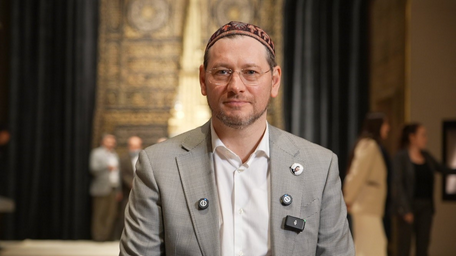
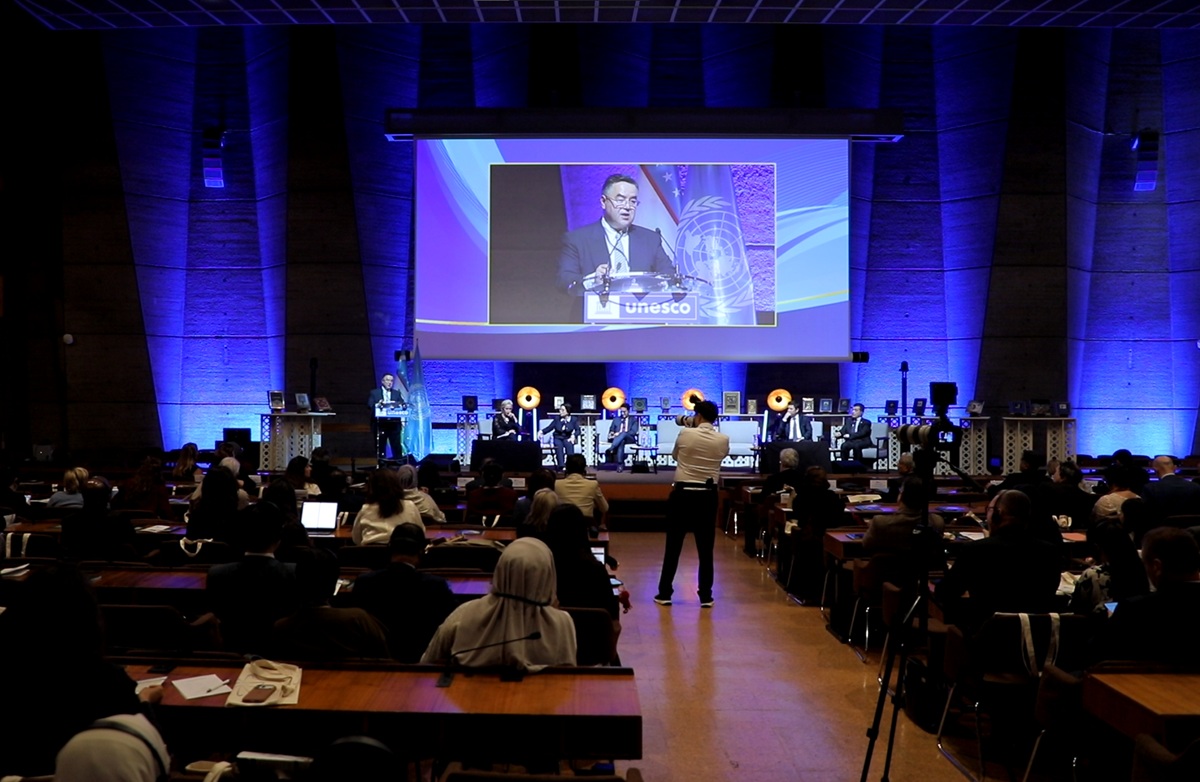
 Presentation of the Center of Islamic Civilization at UNESCO. Photo: CIC
An international conference, «Islamic Civilization: The Great Spiritual and Scientific Heritage of Transoxiana and the Horizons of Enlightenment,» has been held at UNESCO headquarters in Paris. More than 300 scholars, diplomats and representatives of international organizations took part, the press service of the Center of Islamic Civilization (CIC) in Uzbekistan reported.
Participants discussed the contribution of Central Asian scholars to the development of world civilization, the preservation of historical and cultural heritage, the digitization of sources, and prospects for international cooperation in science, culture and education.
The conference was organized by the CIC, Uzbekistan's Permanent Delegation to UNESCO, the National Commission for UNESCO, the Ministry of Foreign Affairs and the Embassy of Uzbekistan in France, the Committee on Religious Affairs, the international research centers of Imam al-Bukhari, Imam at-Tirmidhi and Imam al-Maturidi, and other organizations.
CIC Director Firdavs Abdukhalikov linked the conference to an initiative announced by Uzbekistan's president in September 2025 at the 80th session of the UN General Assembly.
«President Shavkat Mirziyoyev stressed the need for in-depth study and wide popularization of the scientific and spiritual heritage of Imam al-Bukhari, Imam at-Tirmidhi and Imam al-Maturidi. He also proposed presenting this priceless heritage to the global community at leading international venues, including UNESCO headquarters in Paris and UN venues in Geneva and New York. Today's conference in Paris is an important step in implementing this large-scale initiative,» Abdukhalikov said.
One of the conference's central events was the presentation of the Center of Islamic Civilization. Participants learned about its museum and research work, its projects to preserve rare manuscripts and historical artifacts, and its use of digital technologies and artificial intelligence.
Farhan Nizami, director of the Oxford Centre for Islamic Studies, drew attention to the historical and cultural heritage of Central Asia.
«When we walk the historic streets of Uzbekistan, we see not just beautiful buildings and ancient monuments, but evidence of a lofty, dynamic culture, of creativity, close ties and cultural exchange,» he said.
ICESCO Director General Salim Al-Malik said that presenting the Center of Islamic Civilization at international venues would introduce its work to people who are unable to visit Uzbekistan.
«It is very important to present the Center of Islamic Civilization on the international stage, in particular at UNESCO. People who cannot travel to Uzbekistan to see the Center will at least be able to see it at UNESCO. This demonstrates the enormous contribution of Islamic civilization to the development of the world, science and culture. I also want to express my gratitude to the President of the Republic of Uzbekistan, His Excellency Shavkat Mirziyoyev, who consistently supports Islamic civilization,» Al-Malik said.
Frédérique Bressand, president of the Association for the Study of Timurid History and Art in France, also noted the center's international significance. According to her, it is one of the largest cultural and museum complexes in Central Asia and possibly in the world.
«It is meant to promote the wide dissemination of Islamic scientific and cultural heritage, revealing its exceptional richness, which for a long time remained insufficiently known,» Bressand said.
The academic program included three thematic sessions. They addressed the spiritual and intellectual heritage of Central Asia, the work of the Center as an international scientific and cultural platform, and the contribution of Transoxiana scholars to world science.
Special attention was given to the legacy of Imam al-Bukhari, Imam at-Tirmidhi and Imam al-Maturidi, joint research, academic exchanges and the digitization of historical sources.
The conference brought together representatives of the Oxford Centre for Islamic Studies, the Research Centre for Islamic History, Art and Culture (IRCICA), the Al-Furqan Islamic Heritage Foundation, the Organization of Islamic Cooperation, the Association for the Study of Timurid History and Art in France, as well as Uzbek scientific and government institutions.
The event concluded with a reception at UNESCO headquarters attended by diplomats, scholars and representatives of international organizations. UNESCO Director-General Khaled El-Enany was among the guests.
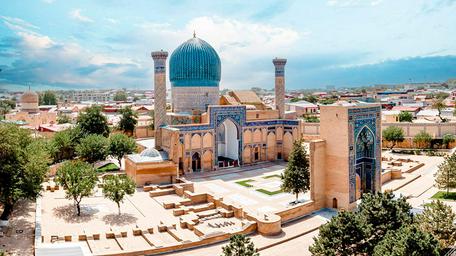
The Center of Islamic Civilization has been built in Uzbekistan's capital next to the Hast Imam complex. The building is designed in the style of medieval architectural monuments, with four portals, each 34 meters high, and a central dome rising 65 meters. It houses a Quran hall, a 550-seat conference hall and a museum whose exhibits span the entire history of Uzbekistan, from pre-Islamic times to the present day. The CIC is intended to serve as a platform for studying the heritage of ancestors and reinterpreting it for today, in cooperation with the International Islamic Academy of Uzbekistan and research and educational centers around the world.