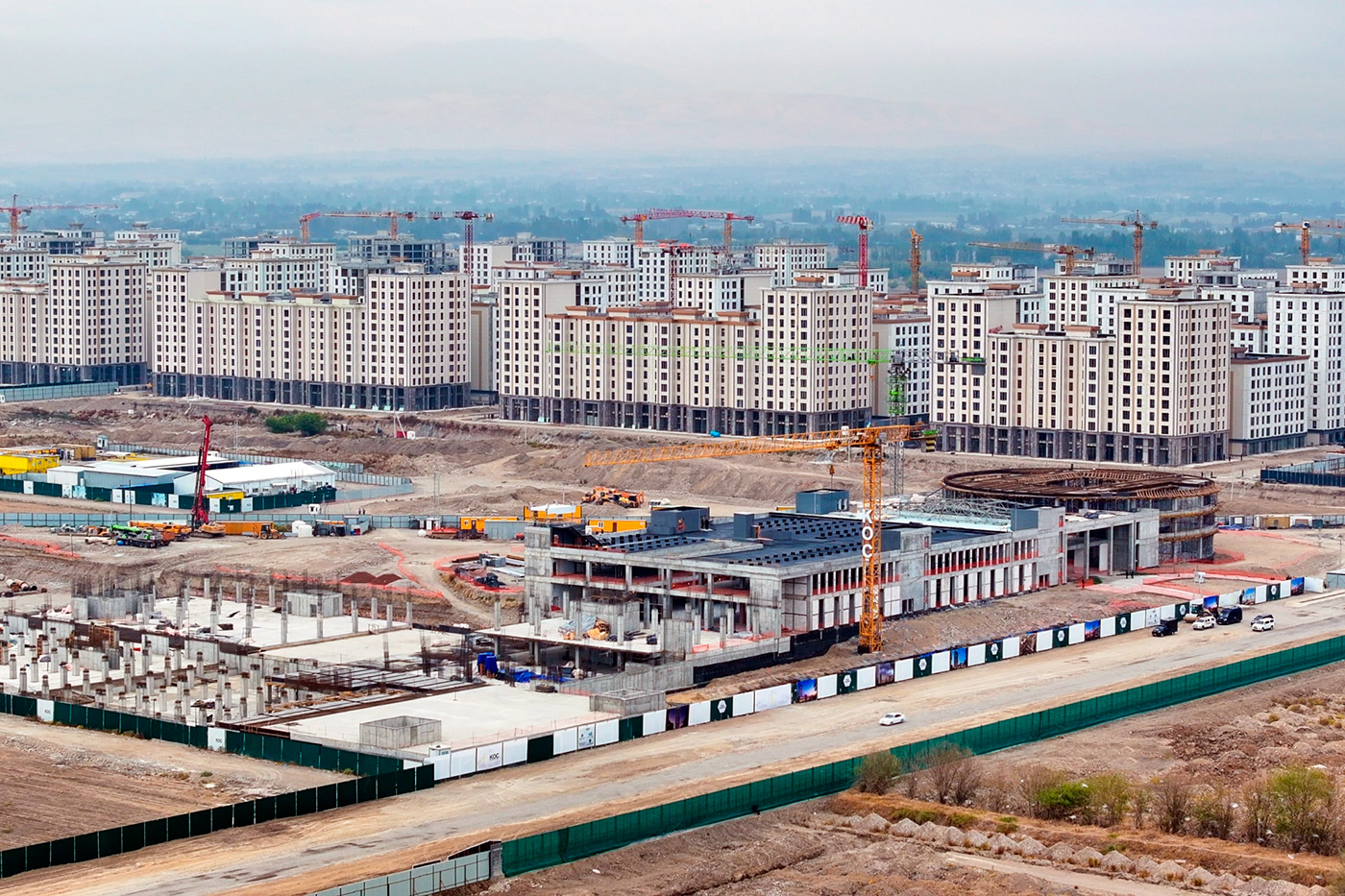
 Fragment of the layout of New Tashkent. Photo by the press service of the Yangi Toshkent directorate
New Tashkent will allocate 100 hectares of land to each district of the capital and to each of Uzbekistan's 13 other regions. President Shavkat Mirziyoyev announced this on October 12 during an open dialogue with investors and entrepreneurs, according to the head of state's press service.
Mirziyoyev drew attention to the shortage of free land in the capital's districts. He relayed a plea from Bobir Abubakirov, the hokim (head of administration) of Shaykhantahur district: «Give us land.» According to the president, there is no land in Almazar or other Tashkent districts, so hokims must prepare projects for New Tashkent, Gazeta.uz reports.
«How to develop these 100 hectares and what the projects should be — all of this must be decided by the mahalla. Here will be the mahalla of Shaykhantahur district, here, Almazar district, here, Mirzo-Ulugbek,» the president said by way of example.
He said each district hokim must devote one day a week to New Tashkent projects and report to him once a month. Regional hokims are instructed to spend five days each month in New Tashkent. The president intends to review each district's projects personally on his next visit.
According to the head of state, New Tashkent should become an example for future generations.
«In 50 to 100 years, people should thank their fathers, our team, for creating such an environment. They should say: 'We live freely and safely in a green space, we raise our children, they go to school and enter university. Here are the best, most modern hospitals, and people come here from all over the world,'» Mirziyoyev said.
The president proposed naming New Tashkent's major streets after the regions and creating mahallas tied to those regions.
«Let's name the major streets, for example, Andijan Street. [...] Imagine a simple dehkan from Kashkadarya saying: 'We also have our own home in Tashkent, our own mahalla. We live in the Kashkadarya mahalla.' How great that would be!» the head of state said.
The New Tashkent project began three years ago. More than $2 billion has been invested in the city so far, but private business is joining construction more slowly than the opportunities allow.
In total, 20,000 hectares have been allocated for New Tashkent. In the first stage, projects worth $50 billion are planned on 6,000 hectares. Construction is so far carried out mainly at state expense on more than 1,000 hectares, while entrepreneurs have received only 94 hectares.
The president stressed that New Tashkent is not merely a residential area. The city must become an independent economic center with business, education, medicine, tourism and services. Yet two-thirds of investors' plots are occupied by residential projects, and construction has not started on 28 lots.
According to Mirziyoyev, the cause is not a lack of money or investor interest. Outdated requirements, protracted permitting and agencies that act as controllers rather than partners are holding things back. He ordered all procedures to be revised, from land allocation to the launch of a facility.
By the end of the year, 20,000 apartments are due to be completed in New Tashkent, housing at least 70,000 people. Residents will also need recreation, sports, retail, education and healthcare. A 55,000-seat stadium built to FIFA standards is under construction in the city. Because Tashkent will host the FIFA U-20 World Cup next year, officials were told to assess demand for hotels, cafes and entertainment and to prepare specific investment proposals for business.
The president said the city's master plan should not hinder investors' initiatives. If a project is of interest to the city, the plot's size or the facility's purpose can be changed promptly. The New Tashkent directorate was instructed to increase the number of plots with a ready concept, project documentation and construction permit. The Saint Petersburg block, which interests business, was cited as an example.
A Swiss Challenge mechanism will be introduced for large commercial facilities. After an investor's initiative is publicly announced, other participants may offer better terms. If none emerge, the plot will go to the initiator.
Infrastructure payments will be cut threefold for retail, services and business centers, fivefold for hotels and tourism facilities, and tenfold for culture and entertainment. For private kindergartens, schools and hospitals, the payment will be 1%. The new rules will also apply to projects already under way.
The state will cover the cost of «green» certification for non-residential facilities worth more than $50 million. The requirement for investors to landscape 30% of their plot will be scrapped; that share will be greened under the master plan at state expense. Each project worth more than $50 million will receive a dedicated escort until commissioning.
The first 50 lots for foreign investors are ready. A package of proposals with economic calculations and information on opportunities will be sent through diplomatic missions. Ministers have been instructed to present New Tashkent projects regularly to major foreign companies.
The meeting also reviewed construction progress at the Shirin massif in Samarkand. The president noted that work is moving slowly: only 19 hectares have been allocated to entrepreneurs, and the rest of the territory remains undeveloped. The regional administration and other agencies have still not begun relocating their buildings. Mirziyoyev said the inaction of state bodies discourages entrepreneurs from investing. It was decided to extend to Shirin the benefits and opportunities offered in New Tashkent.
Addressing the split between domestic and foreign investors, the president said: «Capital, advanced ideas and honest work have no nationality! Everyone who builds New Tashkent and Shirin contributes to the country's development."
Mirziyoyev said demand for land in New Tashkent is growing. In 2024 a hectare cost less than 10 billion soums ($833,000); now the price is up to 19 billion ($1.6 million). Counting the new airport, the president put the territory's investment potential at $200 billion. The city plans 2,000 hectares of green zones and 500 hectares of parks.
The relocation of state agencies is also shaping the city's business life. The ministries of construction, transport and energy already work there, and buildings for other agencies are under construction. The remaining ministries and state bodies will also be moved to New Tashkent.
On the day of the dialogue, Mirziyoyev commissioned seven facilities in Tashkent worth a total of $1 billion and launched construction of ten more large projects worth $2.5 billion.